In August we always went down to the property on the coast for a five week holiday. The first holidays spent at the coast had been to a resort called Diani Beach, where we were accommodated in hired bandas. We used to walk along the coast towards Mombasa to the mouth of the crocodile river – a favourite picnic place with an old ruined mosque and a huge baobab tree. On one occasion we crossed over and continued to explore the coast and eventually discovered a long beach with a large sand island exposed at low tide. Zoe was very excited about this place and in the days to come she went into Mombasa and saw the various authorities and some time later the Fosters bought this property, later known as Sand Island Beach (SIB).
They had to make a road to it branching off from the main road, running from Likoni Ferry South and serving the various properties then in existence. They built one large banda with several bedrooms and a main dining area and later added several smaller double room bandas. This then became our great August holiday place. On one of our earliest trips to the coast I remember that we travelled in a box body vehicle loaded with baggage, Hugh driving with Zoe beside him. Francis (with his left arm in a sling as he had dislocated it falling out of a tree) sat astride the left mudguard with a leg each side of the headlamp and held on to the emblem on the bonnet. Robert was on the right mudguard and Neville and I took turns sitting in the back or wedged behind Francis and the spare wheel, which was mounted on that side of the car. Bearing in mind that we travelled the 550 miles from Kaptagat to Mombasa, it seems remarkable that we not only survived but were not stopped by the police. I suppose it’s possible that travelling this way wasn’t illegal in those days. I do remember how enjoyable it was with the wind blowing in one’s face and the views as we drove. I was never car sick on these occasions.
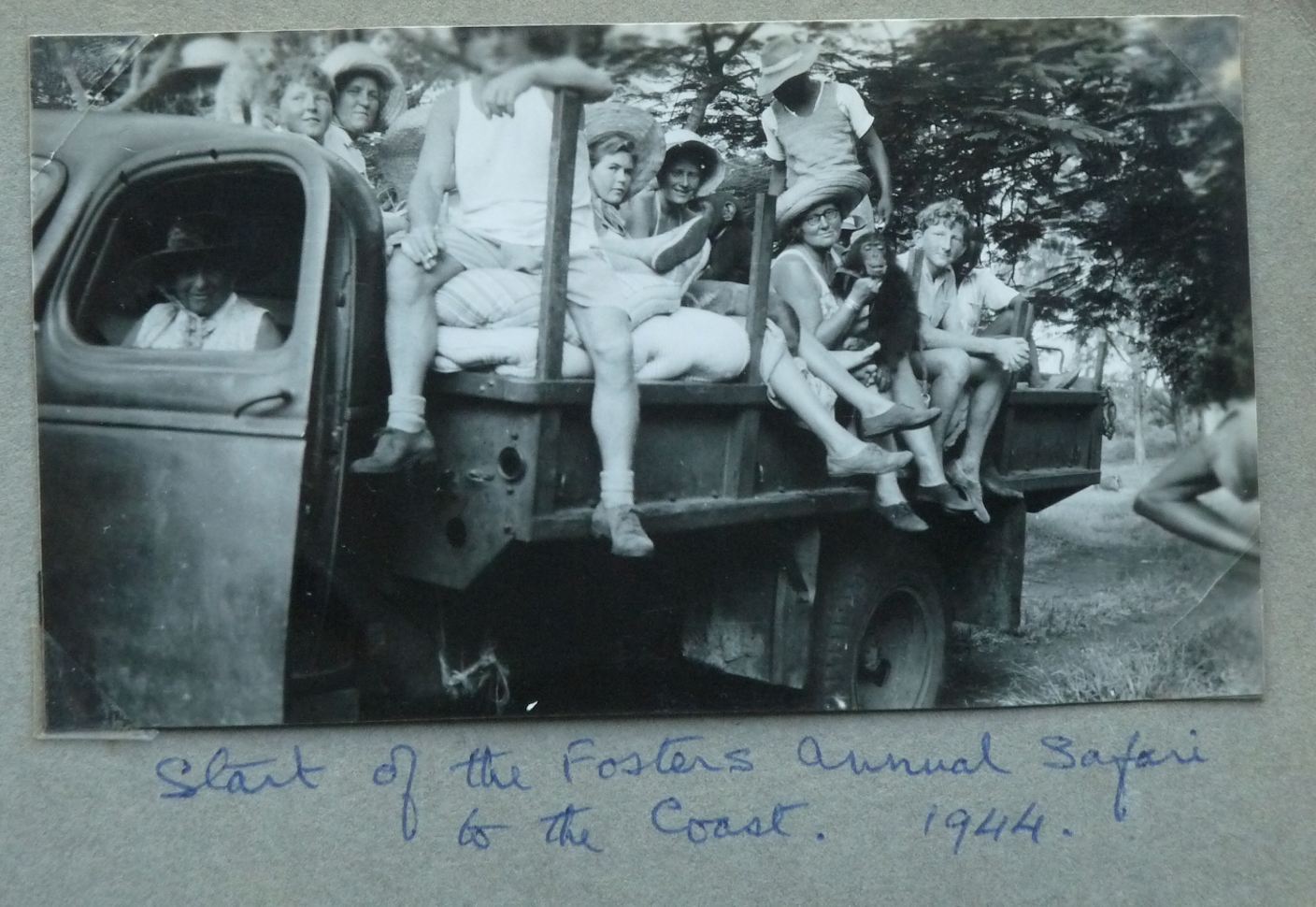
On subsequent occasions we either travelled by train or in the five tonne lorry with all our goods, mattresses etc piled up on the back. They were all cleverly arranged with hollows to seat children, Zoe and sometimes animals; my spaniel, Brenda, occasionally a bird (the grey parrot) or, on one occasion, a toucan, which for some reason I can’t recall, we couldn’t leave behind.
Shortly after the baby-snatching episode, we took Andy on the Mombasa run on the back of the lorry. It was decided to break the journey in Nairobi. Andy caused a great deal of interest when we parked in the street with crowds gathering to see him. It was late in the evening and Zoe told us that we would be spending the night in the New Stanley Hotel. I don’t know if she had discussed the matter of Andy with the Manager or not but she instructed Neville and I to smuggle him up the fire escape to the second floor and get him into our room and to stay with him. We succeeded in this and got him into our bedroom which had two single beds. At supper time we all trooped down to the dining room, having given Andy his food and tied him to the bedpost. In the middle of our meal the Manager of the hotel appeared, along with a terrified African employee, who said that when he went into our bedroom to put down the mosquito nets he was tackled round the knees by a terrible hairy monster! Zoe had to confess to the subterfuge but promised that she would bring him down to supper and the Manager would see how well behaved he was. Of course, dressed in his little red sunsuit and sitting at the table eating with a spoon, he soon attracted most of the guests in the diningroom. They crowded round and several asked if he would be there for breakfast, when they would bring their children to see him. This was the case and the Manager ended up being quite pleased with his full dining room the following morning.
I think it was on that holiday to the coast that we read an advert in the Mombasa Times “Baby chimpanzee for sale £100”. We traced the owner to a back street in Mombasa. He was an Indian trader and was trying to get rid of the baby chimp who was about six months old. He had been clubbed in the face and one side was badly swollen and several teeth and splinters of bone seemed to be causing him a lot of pain. He looked a pale yellow colour and near death’s door – quite limp and unresponsive. Zoe bought him for £50 and we took him straight to the nearest vet, who cleaned out his whole mouth and gave him a shot of penicillin. We left with Stephen (as he was now named) wrapped in a blanket and sucking a bottle of warm milk. During the following fortnight he recovered his full health and was the most delightful pet we ever had. Much more intelligent than Andy and totally amenable due to his sticky start in life. He would cry piteously if reprimanded and try to wriggle his way into one’s arms and be forgiven. He learnt to ride a tricycle, would eat with a spoon and drink out of a cup and in fact sat at the dining room table with the family for meals. Nowadays, this way of treating an animal is totally out of fashion, and I wouldn’t agree with it either, but at that time it was considered most amusing and entertaining. Chimps love showing off and copying and Stephen was no exception. On the farm he would sometimes accompany us into the bathroom and sit on the edge of the bath, squeezing out the sponge or drawing with his finger on one’s soapy back. Neville and I always bathed together (the bath was huge) and with the water as high as it would go we would soak, chat and often read our books. On one occasion I remember handing my book to Stephen to put down on the bathroom stool, instead of which he dropped it in the toilet and pulled the chain!
During the rainy season the bath-water was always chocolate brown in colour. It was heated by wood stacked under a galvanized drum and filled from the nearby water furrow. Consequently it was possible on occasion to get a small boiled frog in the bath with you! I think one of the reasons I find it difficult to worry too much about hygiene is that life was pretty basic and unhygienic on the farm. The crockery was washed in the water furrow by Cheptuum, the cook who squatted by the side of the furrow, rubbing the plates with ash and rinsing them in the water, while the muskovy ducks swam round eating the bits that floated off – and doing what they always do in the water! The kitchen itself was very primitive with a wood-fired stove that filled the little room with smoke. Next to the stove was a wooden table on which Cheptuum cut up meat, vegetables etc and, occasionally, scrubbed with a wire brush. Everything in the kitchen was black with smoke and out of this murk Cheptuum would produce fabulous meals. Zoe did a good deal also, making pastry, bread, bottling fruit and making jam and marmalade. Milk from the farm herd was put through a separator and we had jugs of thick cream with our porridge at breakfast.
Living with the Fosters during the school holidays, Zoe made me feel entirely one of her family. In the early days there was often a war between the boys and the girls. Robert and Francis put a muskovy duck through the bathroom window and into our bath while we were bathing. In retaliation we sowed up the bottom of the legs of their pyjama pants and dropped slugs into them. If the three younger ones got into trouble, it was often Neville and I who got the blame for not looking after them. On one occasion, at lunchtime, Hugh asked, “well what have you children been doing this morning?” Normally, no-one would have answered such an uninteresting question, but on this occasion Mary, aged about five, said casually “We been playing fucking”. There was a ghastly silence and we all stopped eating. Robert and Francis went bright red and the rest of us just looked horrified. After lunch Zoe rounded everbody up and asked just what had been going on. Apparently Mary had come upon Robert and Francis in the long grass at the bottom of the garden (fully clothed) lying on top of two girls, Inge and Grethe Jorgenson, also fully clothed and children of a neighbouring farmer, and when she asked what they were doing, they had apparently replied “playing fucking”. In the event, all participants had found it fairly boring and had gone on to some more interesting activity and thought no more about it. Neville and I got a right roasting for not keeping an eye on the younger ones. This was clearly an impossible task on a huge farm where we were all doing vastly different things.
It was a wonderful care-free life. We all wore khaki shorts, including Zoe (although ours buttoned at the side and had no flies), brown plimsoles which we called sand shoes and loose cotton shirts. We never bothered to change to go riding, which we often did, and sometimes Zoe would accompany us. One of our favourite rides was about twelve miles to the very edge of the escarpment. We would take a picnic lunch in backpacks and when we got there, would tether the horses to nearby trees and enjoy the wonderful view. Although we had so many wild creatures to look after on the farm, I remember that Neville and I adopted two baby pigs from the farm pig sty and called them Gert and Daisy. Hugh was very against the idea and perhaps he was right. They were very amusing when they were tiny, very pink with white bristles and long white eyelashes. We bathed and scrubbed them and even rinsed them in ‘Blue’ to keep their hair shining white. But inevitably they grew up and became less attractive. Unfortunately, when they were returned to the sty, there would be occasions when they would roam. One night at about 11pm Hugh awoke to hear a grunt or cough in his bedroom. Thinking it was a leopard, he seized the gun which lay by his bed and switched on the light to see this huge pig snuffling about at his feet! He was furious. He was always extremely bad tempered if woken at night and made matters worse by belabouring the pig with his slipper. A full grown frightened pig on the run can play havoc in rooms full of furniture. We all woke up and rather enjoyed the fun but I’m afraid Gert and Daisy ended up as bacon soon afterwards!
On another occasion, Zoe told us that she had woken her husband up to announce that there was a huge black beetle or maybe a tarantula in the bed. Never in the best of tempers when awoken, she nevertheless persuaded Hugh to strip the whole bed down to the mattress. At this stage he suddenly stopped and asked Zoe how she could possibly have seen a BLACK spider or beetle in the dark. Zoe roared with laughter as she realised it had all been a dream!
There was an adventure of some sort every long August holiday. One such was a trip to Lake Rudolph. We took a five tonne lorry and some other vehicle, maybe a landrover, the latter being driven by Fronny with Lil sitting beside him knitting all the way (a jumper for Mary I expect). We were all piled up amongst the luggage and mattresses on the back of the lorry and it was a wonderful trip. The first night we camped, no tents, just campbeds. After a good supper over the open fire we all climbed into bed early because we were going to make the last leg of the trip starting at 4 am. We were hauled sleepy eyed out of bed in the dark and raked over the embers to get some warmth, drinking hot tea with condensed milk out of tin mugs and eating wedges of bread with charred sausages. It was great! Four-foot spiders webs gleamed in the bushes, beaded with dew and shining in the starlight. We breathed out clouds of hot breath into the cold air. We were as happy as Larry but the male adults of the party were not. It seemed that someone had forgotten to pack the cigarettes and so the grown up males behaved like spoilt children, stumping around and generally spoiling our breakfast. I think that was when I decided never to take up smoking. We had a very hot drive across miles of flat sandy plains until we reached Lodwar where we were given refreshments by the District Commissioner and while he talked to our elders about the dangers of crocodiles in the lake (no women had ever visited Lake Rudolph at this time), we sat on the edge of his primitive concrete swimming pool and cooled our legs.
The last half of the journey was uneventful and we arrived at the shores of the lake and set up camp on the sand by the lakeside. We only had one tent for goods and bedding and slept on campbeds out in the open. It was amazing lying there looking up at the night sky. At dusk great flocks of ducks and geese flew low over our beds on their way to wherever they slept for the night. You felt you could just reach up and touch them and the noise of their wings was deafening. There was a good breeze and no mosquitoes – which was fortunate as we had no nets. We stayed for three days and filled our time fishing. The local fishermen took us out in their canoes and one or two larger craft. There were a lot of not very large fish which were our staple diet and most of us caught quite a few, but the real thrill was to catch a Nile perch. Hugh and Fronny were quite successful and I remember one that weighed ninety pounds. We got very hot and longed to swim so Zoe let us throw off all our clothes and venture into the clear water just two or three feet deep. I have a photo of us paddling about on our hands with naked unsunburned white bottoms sticking out of the water. Zoe sat on the bank and fired her 303 over our heads into the water beyond to scare the crocs – of which there were many. On the return journey we were very touched to see a lone Turkana on the track holding up something to us. It turned out to be a blue cardigan belonging to me which must have dropped off the lorry on our journey to the lake. We gave him some reward and thanked him very much. I wondered how long he had been patiently waiting for us to return but realised that with bush telegraph, he probably knew exactly.
Apart from this holiday most of our summer holidays were taken at the coast property. Several of these were marked by particular events. I have mentioned a couple of our journeys down by car or lorry but others were taken by train. We would leave Eldoret in the morning and leave Nairobi at about 4 pm. I can remember looking out of the train window and seeing masses of game on the Athi plains – kongoni (hartebeeste), Thompsons gazelles, Grant’s gazelles, wilderbeest, zebras, giraffe and ostriches. Then darkness would suddenly shut-down and we would go along to the dining car for supper. The carriages were four berth or two berth (coupes). The seats were dark brown rexine and the one that you leaned against was hinged and pushed up to make the top sleeping berth. An African railway attendant would come along with your bedding and lay it out for you – top and bottom sheets, pillow in a white case and a heavy dark brown blanket. The train windows had glass which could be pulled down but also a fine wire net and also a slatted shutter. We usually used just the wire net which meant you could keep cool but not have too many insects. We often woke at the many stations on the way and leaned out to watch the little African watoto plying their trade up and down the train – bananas, coconuts, chapatis and trays of samosas or other African fried cakes, dried fish or whatever.
The best thing of all was waking up to that slightly hot sticky sweaty feeling that meant we were nearly there and the sight of the odd palm tree or groves of bananas. We always ended up first thing in the morning treating the rows of bites along our backs or legs from bed bugs that lived in the cracks of the bunks! Just in time to get breakfast – lovely slices of orange pawpaw with a squeeze of lemon juice, scrambled eggs and toast and then gathered ourselves to get out at Mombasa station, pile into the old Chev or whatever the men had travelled down in (they never travelled by train with the noisy family!) and off to the Likoni ferry which carried passengers and vehicles from Mombasa Island to the mainland. I think our turn off the main Tanga road was about 12 miles. You then bounced down this incredible track, avoiding the worst chunks of coral, through various coconut and banana plantations and eventually up to the back of the bandas.
The main banda had a huge long dining room table where we all ate our meals which were cooked out the back by Cheptuum of course. We slept in the little bandas. Lil and Fronny and Hugh and Zoe had bedrooms off the main dining room. There were some rules, one of which was “no bathe no breakfast”. Not too irksome you would have thought, but it really caused a good deal of trouble and much enjoyment to some of us. Robert and Francis were not keen on early morning swims and with their red head tempers, baiting them as they sullenly came down to the beach was a great pleasure. One day Robert was refusing to come down and swim and Zoe was getting very cross with him and trying to drag him along by one arm. He broke away from her and rushed backwards up the beach shouting “you’re just a … a … great farting ant” – obviously the very worst thing he could think of. As he turned to flee he fell straight into the arms of his father who carried him down to the water’s edge and hurled him in! Our beach in those early days was entirely private and we often swam naked, at least with Zoe – I can’t say I remember the men shedding their swim suits, but then they didn’t swim that often – in fact I’ve no idea what they did most of the day as we were too busy with our own lives. We had little fishing nets and buckets and spent hours out on the exposed reef at low tide. Every little pool was filled with tiny tropical fish, there were shells of all sorts and just so much to look at, poke at, capture and put in a jar or just squat and watch. On some occasions, when there was a low tide about 7 pm, we would take hurrican lamps, each one of us armed with a length of iron rod, and would go out on the reef to find eels. These would be moving around from pool to pool on the surface and the idea was to kill them by hitting them behind the head with the iron rod. Of course we were not all that clever at getting it right and it was terrifying to bash an eel and have him squirming around your feet with snapping jaws. There was a great deal of screaming and dodging around but eventually we would return to the banda with a kikapo full of squirming eels and tip them out on to the table. Those that were still alive would have their heads cut off and we would then set to to skin them. It was perfectly possible to get a nasty bite from a severed head, so the squeals and accusations would continue. I can’t actually remember eel stew as being worth the effort really but it was all fun. In the evenings we would often play card games on the long dining room table, racing demon and pelmanism being two favourites.
Many of the holidays to Sand Island Beach were marked by adventures of one sort or another. When Neville and I were in our late teens we invited some young men to visit us. This came about because we used to wave to the little biplane that patrolled the coast every morning at about 10am. Who they worked for or why they carried out this patrol I have no idea, but sometimes when we were bathing, they would swoop down and answer our waves by tilting their wings. One day at low tide we decided to send them a message, so we waded out to the exposed sand island and wrote in huge letters of brown seaweed ‘We are the Fosters – please come and visit us’. Some days later a car turned up with three or four young men from the plane who had come in answer to our message. We gave them lunch and generally entertained them for the afternoon. I don’t remember if they returned again. I think they were probably older by quite a few years! I believe one, a New Zealander, did actually become a good friend and later visited us at the Kaptagat Farm. I think there’s a mention of him in Francis Foster’s book about the family.
On another occasion Neville and I had walked a mile or so down the reef to another beach and we found what appeared to be a mine half buried in the sand. After the adults had duly confirmed this we reported its existence to the Navy in Mombasa and they sent two very smart young Naval Officers out to blow it up. They were pristine clean in white shorts and shirts, white stockings and shiny black leather shoes. Neville and I undertook to take them to the beach. We took one of the African fishermen with us to try to find a way down from the road and eventually hacked a way through the bush with the Navy carrying all their equipment. They then wired it all up and we climbed back into the bushes while they lit the fuse and rejoined us. It didn’t make much of an explosion as it was very dead but it left an interesting great hole.

Thereafter this was known as the Mine Beach and the events were catalogued in our coastal diary. This diary was filled daily on every holiday and at one time we were all made to take turns in recording the days’ events. I do hope it still exists as I would love to re-read it one day. The other thing Zoe did was to embroider a cushion cover each holiday with the signatures of everyone who was staying. We often brought friends down with us.
The best adventure was the holiday of the wreck’. On this occasion we discovered that quite a large sized cargo ship had run aground on the reef and was heeled over towards the seaward side, presenting her large metal side almost parallel to the reef. At low tide it was deemed possible to swim out to her and get a rope aboard and haul ourselves up. The men, Hugh and Fronny, went first and eventually Neville and I and the boys were also able to get aboard. It was most exciting, if a bit perilous. We swam down into the dining saloon and were able to walk on the table tops and Neville dived down and opened the fridge causing also sorts of strange things to float out! It wasn’t possible to explore very far because of the seawater sucking in and out and the danger of torn metal. Up on the deck Hugh and Fronny were doing a great work of retrieving the ship’s bell and anything else they deemed suitable loot. Unfortunately, not long after this, the Navy arrived and decided to set a guard on the shore opposite the wreck to stop unknown persons (!) vandalising their property. Neville and I met up with them, very personable young men in smart white togs, white stockings and black shiny shoes. We lured them back to the bungalow for tea and card games while Hugh and the others continued plundering the ship. Eventually a high spring tide made it possible for them to detach the entire bridge and float it down the coast and eventually bring it ashore. It now stands on an old ruin and has acted as a bedroom for many years.
Aunt Lil was always rather posh and, on one occasion, was having some friends to tea. She wanted the best china tea service with a hand knitted tea cosy over the pot. She went out to the kitchen and instructed the new houseboy, wearing a new white Kanzu with a red cummerbund, to serve the tea using her newly knitted tea cosy, to the guests through the hatch.The hatch had not been used before this day. After her guests were seated, Aunt Lil rang a little bell for tea. There was a long pause and then a foot appeared through the hatch and was withdrawn and then a tea tray passed to Aunt Lil followed by a head wearing the tea cosy with the ears sticking through the side holes with an apologetic little face underneath it.
 Best Beloved