Rene was brought to UK by my father to have a huge heart operation. The outside lining of her heart had calcified so that it could not beat properly. The operation she had had only been performed a few times before. She survived and they went back to Kenya to have a very happy year. I had travelled out with them and so they left me in digs in Kensington while I attended St James’s Secretarial Course in typing, shorthand and bookkeeping.
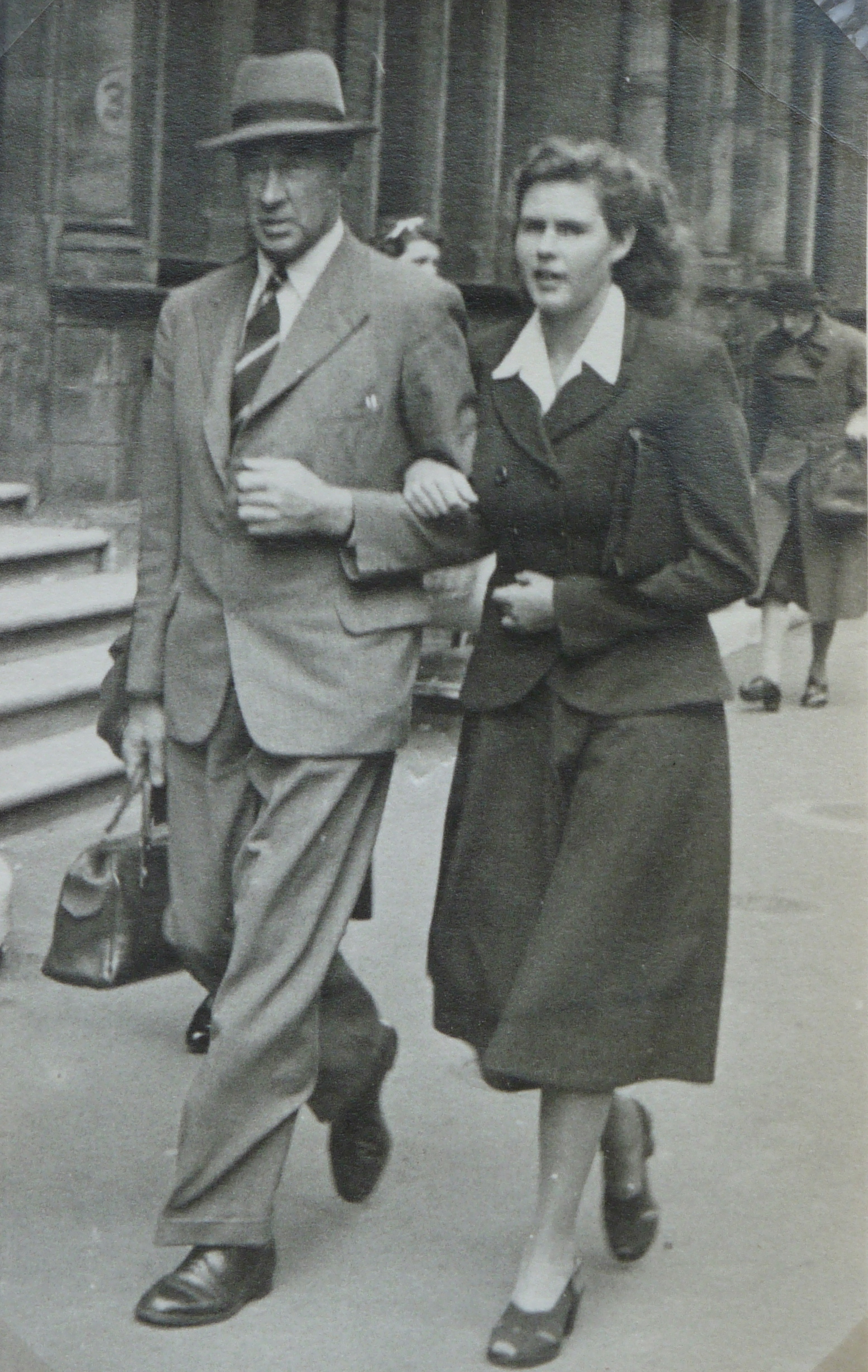
The Kensington digs were rather posh and fairly pricey. The Lady of the house was always popping her head out and if one was caught speaking to one of her good-looking sons on the stairs she would bark “NO fraternising with the lodgers James”. I soon moved on to cheaper places which meant more money for other things. Unfortunately the girls who were in the same class at the college mostly lived with their families and so I was often pretty lonely at the weekends. I used to walk a lot and visit galleries and museums. On one occasion I got completely lost and asked a young policeman the cheapest way to get back to Kensington. He said he was just going off duty and if I liked to come home and have lunch with him and his Mum he would escort me home. That was very enjoyable.
After my training I had various jobs in London but Rene became ill so I returned and worked for my father in his office in Eldoret. Rene’s health deteriorated and she was admitted to the Maia Carberry Nursing Home in Nairobi. My father and I went up to stay with friends so that we could visit her. She died a week later. Some time afterwards my father wrote to the heart surgeon in London to tell him about her death. The surgeon replied to the effect that the scrapings off her heart had been of tubercular origin and he was not surprised at the sad outcome which must have been leukemia. My father was very angry as he felt that if the doctors in Nairobi had had this information they might have been able to treat her.
After Rene died I remained with my father and worked for him in the office. We did a lot of sailing at the weekends out at the Lessos Sailing Club where they had friendly races between the dozen or so yacht owners. It was a happy and sociable club. I was very friendly with Roddy Williams whose land was part of that taken up to build the dam. He lived with his mother and it was often thought that although there were a good many girls he might have married, they all knew that they would have mother with them for life! He had staying with him a young chap called Jack Stevenson who was very good looking and much sought after at the yacht Club. My father and I were due to fly to the UK for a holiday, to hire a yacht and do some cruising. Jack and I were very interested in each other and so my father suggested that if he could get himself to the UK by the right date, he could join us there. Jack had no money so he departed to Mombasa and approached all the ships, looking to work his passage to the UK. He finally got taken aboard a Norwegian cargo vessel as the lowest form of life, a “greaser”. This entailed crawling about in the bowels of the ship applying thick grease to the main prop shaft. It was hot, dangerous and dreadful but he stuck to it and arrived in proper time, two stone lighter in weight. He joined us in Erla and we cruised across the channel and up and down the coast of Brittany. All this is recorded in ‘Erla’s Log’ which I think Graham has.
On our return to Africa Jack and I became engaged and were married at Eldoret in the local church with Neville as Matron of Honour and Nicola Huntingford and Sandra Duncan as bridesmaids.
Having no mother to help me I was taken under the wing of Lorna Duncan and others who helped me choose material for a dress (made up by our faithful Goan tailor) and Lorna’s husband, the local baker, made a gorgeous three tiered wedding cake. Ethel and Charles Newton came down from Njoro where they now lived. Charles had finally been diagnosed as having lead poisoning and had taken employment with the Soil Conservation Service.
My father generously gave us a Peugeot 203 as a wedding present and we set off in it to honeymoon. Our first night was spent at the Brown Trout Inn in the Kenya Highlands. I cried myself to sleep thinking of my beloved lonely father. Jack was very sweet and understanding. We drove on down to Mombasa and finally to our new home in Dar es Salaam. This was a flat above a bookshop which was all we could afford – Jack having joined the African Mercantile Marine Company having assured them that he would accept the salary of £60 a month as he wasn’t intending to marry – which was the case at the point he was hired.
Shortly after our marriage and when we were living in Dar, we invited one of the ship’s captains to dinner with us. They very much enjoyed being in a family situation after months on board. On this occasion I had cooked a roast chicken with bread sauce etc and set everything ready on the table in our diningroom. We were having drinks upstairs so, after setting everything ready, I ran up and called Jack and the Captain to come down. We can’t have been more than five minutes but when we arrived in the diningroom there was no chicken. A cat must have jumped through the window and taken the whole thing. All I could find was a tin of sardines which didn’t go very well with roast potatoes etc.
I got secretarial work with the Medical Headquarters and we were very happy. I enjoyed working for the various doctors at Medical HQ and it was there that I met Valerie Vail who worked in the typing pool. There were a lot of interesting characters among the fifteen or so doctors and one of them was especially eccentric. This doctor, who was quite brilliant in his field, suffered from a very poor memory. On one occasion he rushed into his office and apologised for being late because he’d been out sailing – he had thought it was Sunday when in fact in was Wednesday. He frequently lost his car and phoned the police only to discover it was actually where he had left it. On another occasion he drove up to his house at about 7.30pm, walked into the front room and saw a lot of people standing around, upon which he apologised profusely for being in the wrong house (government houses did all look very alike) and was just getting into his car when one of the ladies ran out and said “no no doctor, you are not in the wrong house, you invited us to drinks tonight!”
Graham was born just before Christmas the following year. We had been out sailing with Don and Jill Stanley in their yacht, Salamis. I could swim very comfortably with a cotton kanga knotted around my chest even though I was due to give birth within two weeks and had been floating about goggling over the reef. We lunched on lobsters harpooned by Jack and Don Stanley. That evening we had a drinks party in our tiny flat behind Barclay’s Bank and half way through I started to get pains – which I put down to the lobster lunch, but it soon became clear that they were more than that, so we excused ourselves and departed to the Ocean Road Nursing Home where Graham was born on 17 December l955.
I expect it was quite a normal birth, but at one stage the red-head who was the sister in charge said “it would help Mrs Stevenson if you would make a little less noise and do some more pushing”. I sat bolt upright, absolutely furious and shouted at her “You’re not married and you’ve never had a baby so don’t tell me not to scream.” To give her credit, she just smiled and said “Well that’s done it and here is the baby”. I’ll never forget that amazing thrill of feeling a little wet foot kicking against the inside of my thigh. Poor men – they’ll never know.
 Best Beloved